Naftogaz received a court decision that Kazakhstan's government refuses to implement
The Astana International Financial Center (AIFC) court ruled to recover $1.4 billion from Gazprom — but Kazakhstan's Justice Minister explained why the state has no connection to this body and will not comply with its order.

By Tetiana Suchkova-Ladik
May 25, 2026 · 3 min read
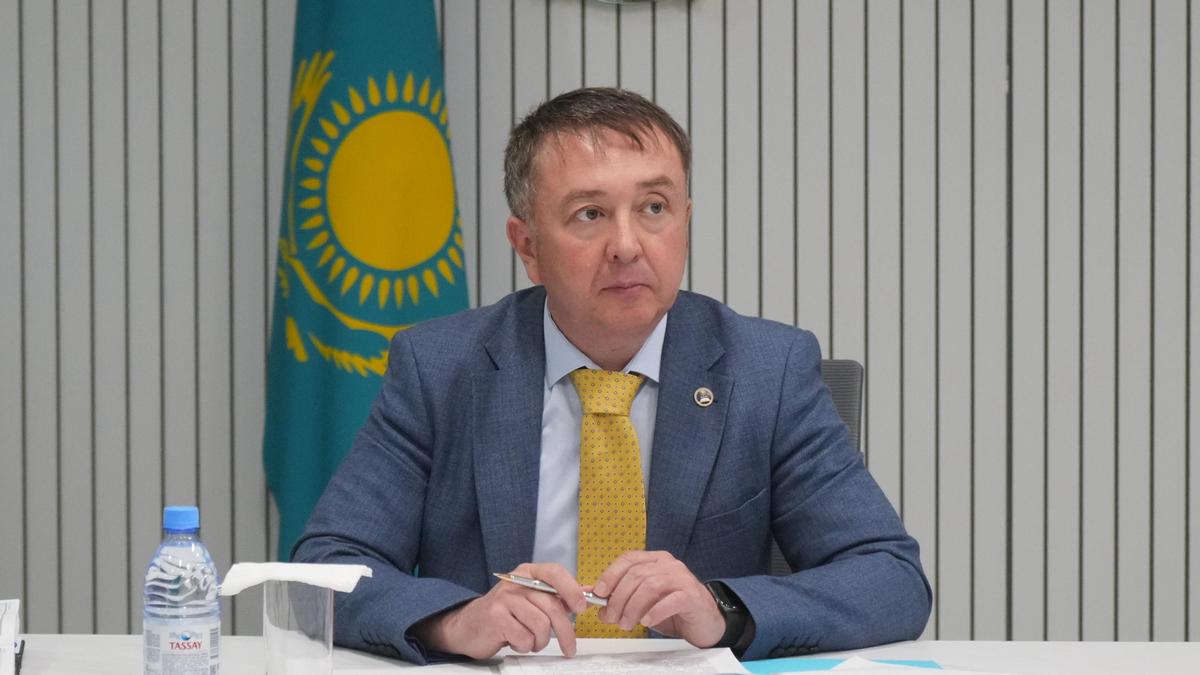
On May 20, 2026, the court of the International Financial Centre "Astana" (IFCA) issued a court order: to recognize the decision of the ICC arbitration in Zurich from June 2025 and to allow enforcement against Gazprom in favor of Naftogaz of approximately $1.4 billion. Five days later, Kazakhstan's Minister of Justice Yerlan Sarsembayev explained why this figure has virtually no chance of materializing on Kazakhstani soil.
What the court decided — and why it's not what it seems
According to the order published on the IFCA website, Gazprom is obligated to pay: principal debt — $1.134 billion, interest until January 31, 2025 — $182 million, late payment interest until January 9, 2026 — $117 million, and more than €5 million in arbitration costs. The total sum exceeds $1.4 billion.
However, as Sarsembayev explained in an interview with Zakon.kz, the order itself has a significant procedural limitation.
"The court order was issued unilaterally — without the participation of the respondent. It is not a final decision: it is merely provisional in nature and has not acquired legal force."
Yerlan Sarsembayev, Minister of Justice of Kazakhstan
Gazprom has the right to file an application to rescind the order within the established timeframe, after which a full hearing with both parties' participation will take place.
Four arguments of "not our jurisdiction"
The Kazakhstani government formulated four grounds why the IFCA decision is not subject to enforcement through state mechanisms. According to Sarsembayev, the case lacks basic elements of jurisdictional connection with the center:
- Gazprom is not a participant in the IFCA
- The disputed agreement was not concluded on the IFCA platform
- The dispute is not governed by IFCA law
- The parties did not conclude an agreement to submit recognition and enforcement matters to the IFCA court
The Constitutional Law "On the IFCA" limits the court's jurisdiction to specific categories of disputes — those directly related to the center or referred to it by mutual consent of the parties. The dispute "Naftogaz v. Gazprom" does not fall under any of them.
Vice Minister of Justice Daniel Vaisov clarified the status of the body itself: the IFCA court is not a state body and does not form part of the judicial system of the Republic of Kazakhstan — in legal terms, it is extraterritorial and operates under English law.
What lies behind the refusal
The geopolitical context is well known to analysts: approximately 50 million tons of Kazakhstani oil are transported through Kazakhstan annually to Russia via the CPC pipeline, and Gazprom supplies up to 7 billion cubic meters of gas per year to Kazakhstan and in transit to Uzbekistan and Kyrgyzstan. Seizure of Gazprom assets, according to assessments by a number of Kazakhstani analysts, would threaten disruptions in gas supplies to neighboring countries — and risk of mirror measures from Moscow against oil transit.
Sarsembayev formulated the state's position succinctly: "The Republic of Kazakhstan will not become a transit platform for enforcing decisions that have no legal connection to it."
Case chronology
- 2019 — Naftogaz and Gazprom conclude a five-year contract on gas transit through Ukrainian territory.
- May 2022 — Naftogaz declares force majeure; Gazprom refuses to pay for transit in full.
- September 2022 — Naftogaz initiates ICC arbitration in Switzerland.
- June 2025 — The Zurich tribunal orders Gazprom to pay over $1.4 billion.
- January 2026 — Switzerland's Federal Tribunal rejects Gazprom's appeal, confirming the finality of the decision.
- May 20, 2026 — The IFCA court issues an order for enforcement on Kazakhstani territory.
- May 25, 2026 — The Kazakhstani government publicly distances itself from the decision.
Naftogaz head Sergiy Koretsky stated that the company "is consistently moving forward and working on enforcement of the arbitration decision in various jurisdictions." Kazakhstan's refusal is not the end of the campaign, but a demonstration of its main problem: obtaining a court decision is far easier than finding a jurisdiction willing to enforce it despite economic or geopolitical pressure.
If Naftogaz cannot find a third country where Gazprom has real liquid assets and where the local government will have no reason to block enforcement, the campaign to collect $1.4 billion may remain a legally obtained — but factually hollow — victory.



