Georgieva in Davos: Complete reforms — the price for access to $8.2bn and a step toward EU integration
The Managing Director of the IMF urged Kyiv to see reforms through to the end. This is a condition not only for a new lending program but also for strengthening economic resilience during the war — we examine exactly what is being demanded and what consequences this will have for the country.

By Tetiana Suchkova-Ladik
January 20, 2026 · 2 min read
Why this is worth reading
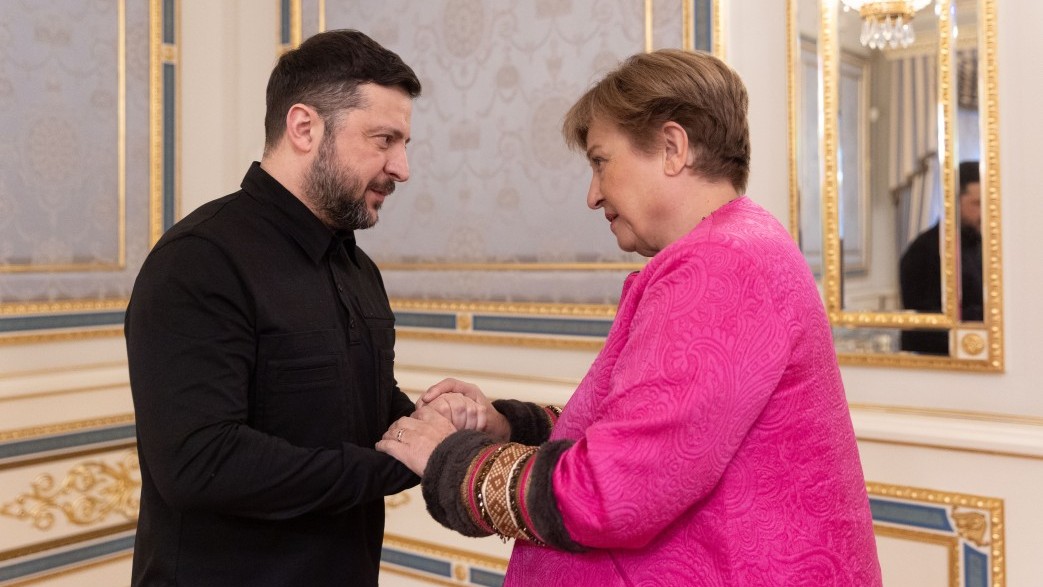
At the World Economic Forum in Davos, IMF Managing Director Kristalina Georgieva openly linked two themes: financial support and reform. In wartime, the Fund’s decisions are not only a matter of money but also a signal of trust from partners. For the reader this means: how quickly and consistently reforms are implemented will determine both the amount of international assistance and the pace of economic recovery.
What exactly Georgieva said
"The country has already done a lot for reforms. But the reforms are not yet complete — and I want to be perfectly frank. If the country wants to become a European tiger — or, better to say, a European lion — there must not remain a single unfinished reform."
— Kristalina Georgieva, Managing Director of the International Monetary Fund
She named key areas: stop subsidizing electricity and heating prices, improve the fiscal system for a fairer tax burden, and remove barriers to private sector development. Georgieva also emphasized the role of EU accession as a "magnet" for investment and as a marker of the quality of reforms.
"I visited a power plant — and it was stunning... They don't grumble or complain — and that is striking."
— Kristalina Georgieva, during her speech in Davos
Financial context: numbers that matter
In November Ukraine and the IMF reached a preliminary agreement on a new four-year program worth $8.2 billion. It will replace the current program of $15.5 billion, from which about $10.6 billion has already been disbursed. The new deal is based on the baseline assumption that the war will end in 2026; the Fund also envisaged a "downside scenario" with hostilities continuing until 2028.
Consequences and risks
The reforms the IMF is talking about are directly tied to money. If Ukraine meets the agreed conditions — it will gain access to $8.2 billion, which will increase financial stability and reduce deficit risks. But this is not just a technical process: the withdrawal of energy subsidies and changes in tax policy will be politically and socially painful. Success depends on consistent government communication, mechanisms to support vulnerable groups, and the pace of reforms.
International partners are watching implementation closely: a financial agreement is not only a tranche but also a marker of trust that opens the way to investment and steps toward European integration.
What this means for every Ukrainian
This means that some will experience changes in bills and services in the coming years, but in return the state will gain greater fiscal resilience and the economy better chances for recovery and growth. In other words: today's unpopular steps are an investment in economic reconstruction after the war and in an accelerated path to the EU.
Conclusion
Georgieva's message is a clear signal: IMF money comes with the requirement to complete reforms. The question is no longer whether to reform, but how to do it quickly, technically competently, and with regard for social risks. The ball is now in the court of the Ukrainian authorities and society: will the state find a balance between necessary economic transformations and supporting people during wartime?