"NBU Mints "CHORNOBYL" as One Word — and It's Not a Designer's Mistake"
A five-hryvnia coin honoring 600,000 Chornobyl liquidators transforms the very name of the catastrophe into an artistic device: the word is split between the obverse and reverse, connecting the temporal dimension of the tragedy with its pain.

By Tetiana Suchkova-Ladik
April 25, 2026 · 2 min read
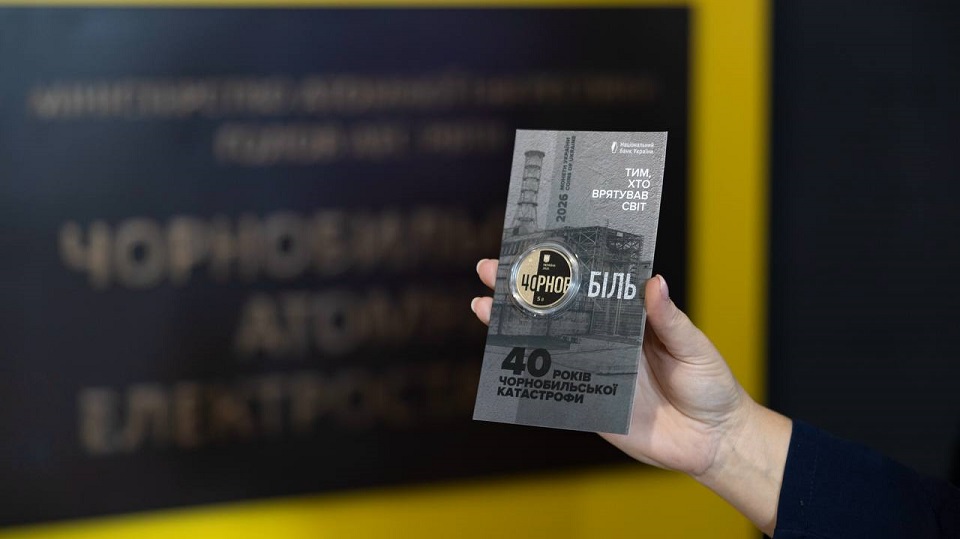
April 26, 1986 — and 40 years later the NBU does what the state rarely manages to do: it transforms a number into an image. The National Bank issued a commemorative coin "To Those Who Saved the World. 40 Years of the Chornobyl Disaster" — and its design proved more accurate than most official speeches.
A Word Torn in Half
On the obverse of the coin is the inscription CHORNOB, where the first two letters are stylized as the number 40. The incomplete letter "B" — is not an oversight, but a compositional transition. On the reverse, the same word reaches its end: BIL (Pain). Together it reads not "Chornobyl," but "Chornob-il" — and in this very rupture lies the entire concept of artist Mykola Kovalenko.
"On one hand, this coin is a reminder that something like this should never happen again. Another symbolic task is to thank all the liquidators who became a shield for the country."
Andriy Pyshny, head of the NBU, at the opening of the exhibition "Chornobyl: 40 Years Later. History That Obligates"
600,000 — and Most Are Gone
The coin with a nominal value of 5 hryvnias is dedicated to the liquidators — people whom the state threw into the reactor literally: military personnel, firefighters, medics, engineers, scientists. There were approximately 600,000 of them. According to the "Chornobyl Union" organization, 10% of them have already died, and another 165,000 became disabled. 76-year-old liquidator Petro Hurin told Reuters that of 40 colleagues from his enterprise sent to the exclusion zone in 1986, only five are alive today.
Those who survived are supported by the state through a system of preferential pensions: liquidators with the first disability group receive 17,486 hryvnias per month (100% of the average salary for 2024), with the second group — 13,989 hryvnias, with the third — 10,492 hryvnias. In practice, this means that a person who received a radiation dose while saving Europe from a nuclear cloud lives on a sum that in most EU countries would not even cover utility payments.
Mintage of 50,000: Between Memory and Market
The coin's mintage is up to 50,000 pieces in souvenir packaging. It can be purchased in the NBU's online numismatic store and from distributor banks. For comparison: previous coins from the "Chornobyl. Renaissance" series sold quickly — collectors report shortages within the first hours of sale.
The question that remains open: if the coin is minted in a mintage of 50,000 and will cost more than its face value, will it reach those very liquidators it is dedicated to — or will it settle in the collections of people for whom Chornobyl remains only the aesthetics of tragedy?