"Promised to cancel after the war — now extended for three years: Parliament enshrines increased military levy"
257 MPs voted to preserve the 5% tax rate for individuals after the end of martial law. This decision is backed by an overdue IMF commitment and $0.69 billion of the next tranche.

By Tetiana Suchkova-Ladik
April 7, 2026 · 3 min read
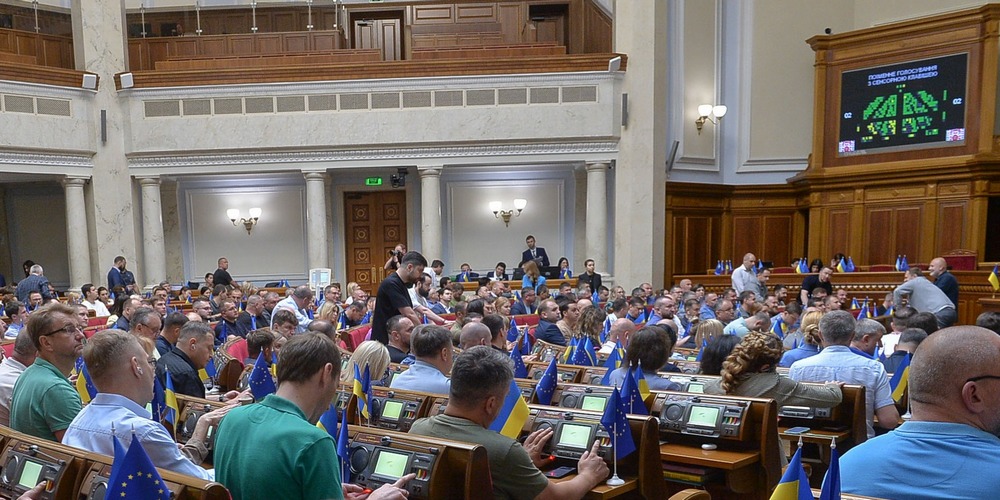
When in 2025 the Verkhovna Rada increased the military levy from 1.5% to 5%, deputies assured everyone: this is temporary and will end with the end of martial law. On April 7, 2026, that same Rada voted 257 times to make the "temporary" measure last at least three more years after peace.
What was adopted
Bill No. 15110 stipulates: for three years after the year in which martial law is lifted, the levy rates remain unchanged. For hired workers — 5%, for self-employed persons in the 1st, 2nd, and 4th groups — 10% of the minimum salary (in 2026 this is approximately 850–865 hryvnias per month), for "single-tax" third-group taxpayers — 1% of income. The exception is military personnel, for whom the rate remains 1.5%.
At the same time, a change is introduced to the Budget Code: funds from the levy will be transferred to a separate special fund — officially for financing defense and post-war reconstruction. The adopted text contains no mechanism for independent control over the spending of this fund.
Why now and why the rush
The bill was passed in two readings at once — this is atypical even for "package" votes. The reason is a debt to the IMF. On February 26, 2026, the Fund approved a new four-year Extended Fund Facility (EFF) program for Ukraine worth $8.1 billion, with the first unconditional tranche of $1.5 billion already received. However, the next — $0.69 billion — directly depends on meeting the structural benchmarks for the first quarter.
"This bill is an IMF benchmark — its adoption is a requirement for Ukraine to receive financing"
— Member of Parliament Yaroslav Zheleznyak, Holos faction
Ukraine has failed to meet all three first-quarter benchmarks: the deadline was March 31. Besides the military levy, parliament had to adopt taxation on digital platforms and parcels, as well as resolve the issue of appointing the head of the State Customs Service. President Zelenskyy publicly called on deputies to vote for 10 key bills in April, emphasizing: regardless of personal preferences and attitudes toward individual ministers.
A broken promise as a fiscal stability instrument
The key subtext of the vote is not the levy itself, but the precedent. The publication dtkt.ua noted directly: "The government decided to back away from its promise". This is the first case where a tax introduced as wartime and temporary is legally enshrined for the post-conflict period before the conflict itself has ended.
The Finance Ministry's logic is understandable: the IMF wants to see that Ukraine is capable of independently financing part of the budget deficit after the war, rather than relying exclusively on external grants. The increased levy is one of the arguments for fiscal discipline for creditors. But specific people from specific salaries are paying the price for this argument.
- Three IMF benchmarks for the first quarter have been missed, with implementation occurring in April with a delay
- The bill on VAT for self-employed persons was not included in the package — this is a separate and currently postponed matter
- The IMF program is designed until 2030 — there are 12 structural benchmarks in total
If the next IMF tranche ($0.69 billion) arrives after April's package of votes, it will confirm that the Fund treats benchmark delays as a technical delay, not a program breach. If not — discussion about the "temporary" nature of any tax promises will become even shorter.



