Shkurakov — Deputy Defense Minister for Finance: transparency, digitalization and strict control of resources
The Cabinet of Ministers has appointed Vasyl Shkurakov to a key financial post at the Ministry of Defence. This is not a mere formality — the decision is intended to ensure that international aid and budgetary funds effectively reach the front lines. We explain what exactly will change and why this matters for security and for public confidence in defence spending.

By Tetiana Suchkova-Ladik
March 27, 2026 · 2 min read
What happened
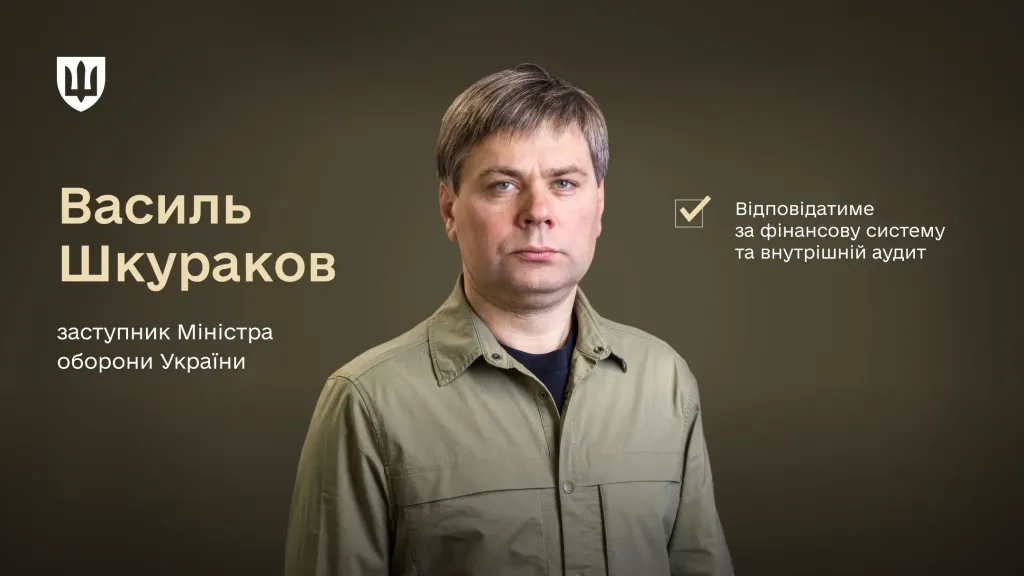
On March 27 the Cabinet of Ministers appointed Vasyl Shkurakov as Deputy Minister of Defence for Finance and Internal Audit. The decision was announced by Defence Minister Mykhailo Fedorov.
"Vasyl Shkurakov will be responsible for the financial system and internal audit. The focus is on building a transparent, controllable and data-driven financial system of the Ministry of Defence"
— Mykhailo Fedorov, Minister of Defence
What tasks has the new deputy been given
The key priorities officially defined for Shkurakov are:
- Budget planning and execution — so that resources reflect the real needs of the front.
- Management of funding sources — the state budget, international aid, grants and loans should be coordinated under a single policy.
- Economic analysis for decision-making — increasing the role of data in planning and spending prioritization.
- Strengthening internal audit — identifying risks, preventing inefficiency and corruption.
- Digitalization of financial reporting — so that every decision is based on high-quality, verified data.
Why it matters
During wartime, what the front experiences directly depends on the functioning of ministerial financial processes: whether there is fuel, ammunition, equipment, or infrastructure repair. A transparent, data-driven system reduces the risk of resource leaks and increases the speed of response to unit needs. For taxpayers and international donors, it signals that Ukraine is betting on accountability and efficiency.
Personnel context
Shkurakov has more than ten years of experience in public finance management: work at the Ministry of Finance (2005–2017), positions at Ukrhydroenergo and Ukrfinzhytlo, and he served as First Deputy Minister of Infrastructure since 2021. In 2024 he temporarily performed the duties of Minister of Infrastructure.
At the same time, the Ministry of Defence made two other important appointments: Mstyslav Banik, who previously at the Ministry of Digital Transformation was responsible for launching Diia and the Army+/Reserve+ projects, became Deputy Minister for procurement reforms; Yurii Myronenko was appointed General Inspector and will be responsible for developing control systems and digital tools within the department.
"We are building a system where every hryvnia works for results"
— Mykhailo Fedorov, Minister of Defence
What to expect next
Now the key thing is not job titles but prompt implementation: the first decisions on standardizing reporting, a roadmap for the digital integration of finances, and a first-level internal risk audit. It's also an important signal for donors: if transparency in the Ministry of Defence increases, the chances of accelerating tranches and technical assistance projects will rise.
Practical questions remain for the government and society: will there be sufficient authority and resources to implement these changes within the first 3–6 months, and how will their results be evaluated. This is exactly what the front and citizens will demand.