Eurozone at a Crossroads: How War in Iran Changed ECB's Forecast and What It Means for Your Accounts
# Euro Zone Economic Outlook Shifts as Middle East Conflict Unfolds The eurozone was on solid growth trajectory through late February 2026. Then the Middle East war began — and the ECB rewrote its forecast. Now between you and recession stands just one question: how long will the conflict last.

By Tetiana Suchkova-Ladik
April 15, 2026 · 3 min read
Until February 27, 2026, the eurozone PMI held at 51.9 — the economy was growing, inflation had stabilized near the 2% target, and the ECB could speak for the first time in years about a "solid foundation." Then war in the Middle East began. In six and a half weeks, it erased this optimism.
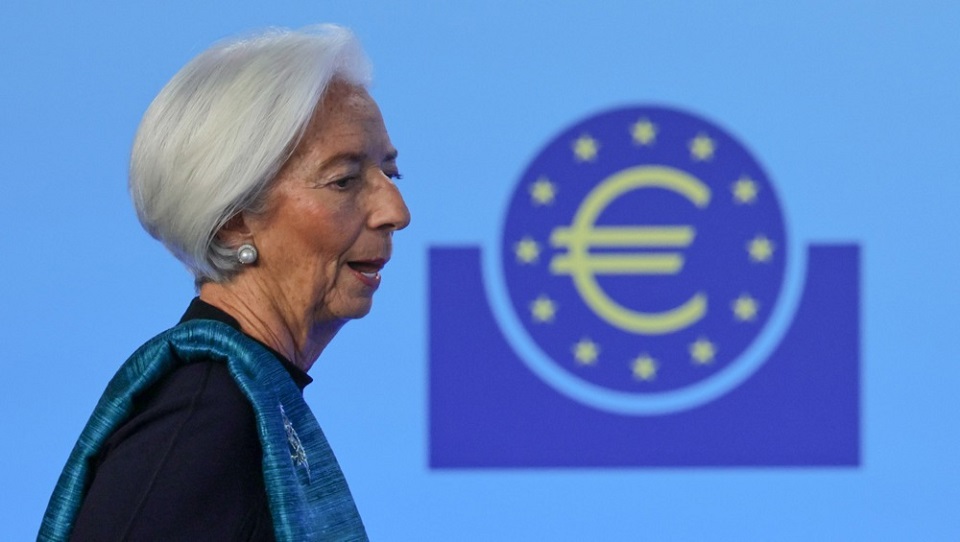
ECB President Christine Lagarde confirmed at an IMF meeting in Washington: the eurozone is no longer following the baseline scenario. "We are between the baseline and negative scenarios," she said on Bloomberg TV, refusing to give a forecast on interest rates.
"This does not determine which direction we will go, and certainly does not give me grounds to confirm a specific rate path today."
Christine Lagarde, ECB President, Bloomberg TV
What specifically changed in the numbers
The ECB staff's March forecast recorded three key changes compared to December 2025:
- Eurozone GDP growth for 2026 was revised down by 0.3 percentage points to 0.9%
- Core inflation for 2026 was raised to 2.6%, potentially reaching 3.1% in the second quarter due to an energy spike
- Oil prices in the baseline scenario — a peak of $90 per barrel in Q2 2026, gas — €50/MWh
This is the baseline scenario. The IMF in its World Economic Outlook, published the same week, lowered the eurozone growth forecast to 1.1% from the previous 1.4%, accounting for a 19 percent jump in energy costs.
Negative and catastrophic: how they differ
The ECB publicly described three scenarios — a rarity for a regulator that traditionally avoids public dramatization.
In the negative scenario, oil surges to nearly $120 per barrel, gas to €90/MWh. GDP decline is moderate and temporary: minus 0.3 percentage points in 2026 with partial recovery in 2027.
In the serious crisis scenario — complete blockade of the Strait of Hormuz — oil reaches $150 per barrel, gas €110/MWh. Inflation becomes entrenched above baseline levels for 2026–2028, and eurozone quarterly GDP registers negative values. This is already a recession.
For an ordinary household, this means: heating and electricity bills in the next heating season will rise, purchasing power will fall, and credit conditions — depending on the ECB's decision on rates — may either remain neutral or tighten.
"The longer the conflict lasts, the greater the potential threat of economic recession."
Lindsay James, investment strategist at Quilter, Euronews
The ECB between two mistakes
The regulator finds itself in a familiar trap. After 2022, it faced harsh criticism for a delayed response to the inflationary shock from the Ukraine war. Now markets are pressuring rate increases again — some analysts predict a move as soon as next month.
Lagarde deliberately dampened these expectations: the ECB has no bias toward either increases or decreases and will act only on the basis of incoming data. As IMF chief economist Pierre-Olivier Gourinchas notes, the global economy previously demonstrated resilience to trade shocks — but the current Middle East crisis has halted this recovery, with Europe among the most vulnerable due to its dependence on imported gas.
If peace negotiations between the US and Iran, which failed last weekend, yield results in the next round and the conflict does not escalate, the ECB will likely hold rates and the eurozone will avoid recession with relatively moderate losses. But if the Hormuz blockade drags on into autumn — the moment when Europe traditionally fills gas storage before winter — the question will no longer be about growth rates, but about the depth of the downturn.